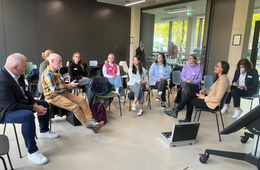
Review: HWNG workshop "Communicating the impact of flooding"
05. Dec 2025
On 9 October 2025, the Hochwassernotgemeinschaft Rhein e. V. (HWNG Rhein) and cooperation partners such as the Stadtentwässerungsbetriebe Köln (StEB Köln) and the Deutsches Komitee Katastrophenvorsorge (DKKV) held a workshop in Cologne on the topic of "Communicating flood risk – How can
local authorities better raise awareness among those affected?".
The aim was to improve risk communication and strengthen the necessary personal precautions. The main task is to counteract ‘flood dementia’ and prepare the population for increasing extreme events as a result of climate change, especially in flood-free periods, without causing fear.
Effective communication must cover three central levels:
- Understanding risk,
- recognising relevance,
- communicating coping strategies.
In order to actually motivate people to take action and dissuade them from a ‘fully comprehensive insurance mentality’, emotional communication is required that conveys self-efficacy and relies on authentic, vivid representations (e.g. videos, 3D models). Experts call for hazards in public spaces to be made visible and tangible, for example through flood marks or water level gauges. A key concept is the establishment of ‘beacons’ – central, walkable contact points in Cologne for information, communication and basic care in the event of a disaster.
These locations should be uniformly marked and serve as social hubs for crisis management. It is important that the population knows how to act independently in the first few hours, as communicating risk awareness and helping people to help themselves must be the first priority. Organisational prerequisites such as clear responsibilities, close networking and cooperation between water management, disaster control and administration, as well as consistent messages, are crucial for the success of risk communication in order to use scarce resources efficiently.
We at HKC would like to express our gratitude for this successful and inspiring day!
Image source: Copyright HWNG Rhein e.V.; Ute Eifler.